

- Our products
-
 My account
-
 Cart
Cart





Connexion
Create an account
Create an account
Connexion

Lore&Science's blog
Discover our range of health supplements specially formulated to support the well-being of dogs, cats, and horses, helping maintain their vitality, mobility, and overall balance every day
-
 Health topics
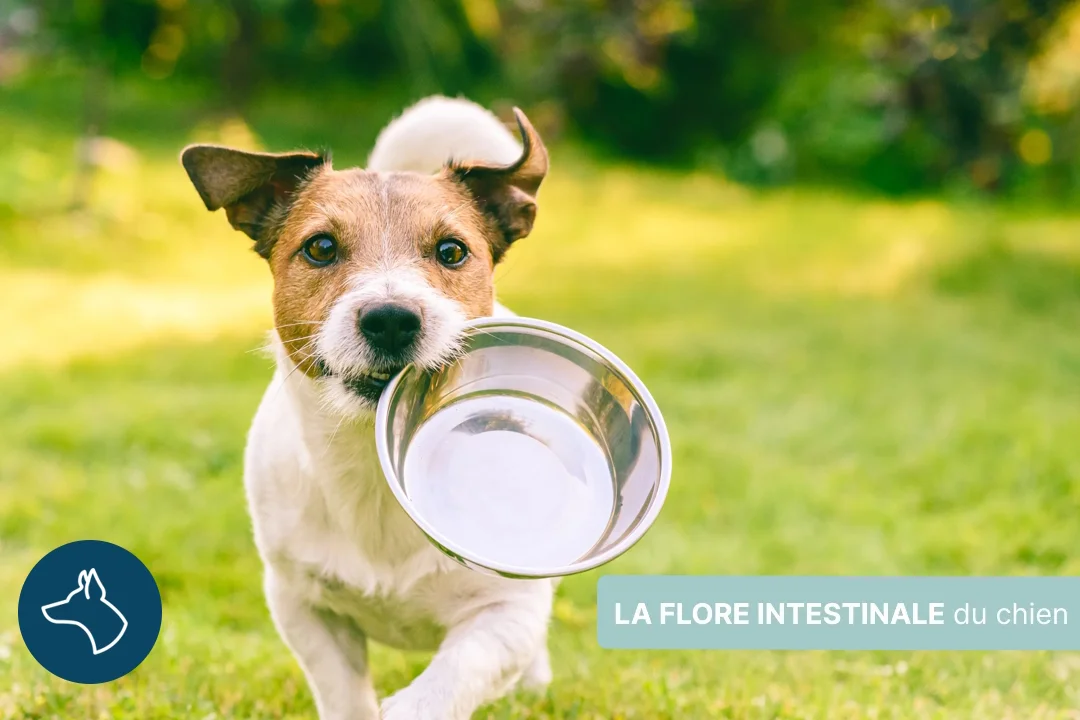
Intestinal flora of the dog, what is its purpose, why support it?
06 January 2025
Read moreThe intestinal flora is an important barrier against the penetration of pathogens. But what exactly is this intestinal flora and how can it protect our dog?
What is the intestinal flora?
The digestive system is home to one of the richest microbial populations on our planet, the intestinal flora. Compared to other mammals, our dogs have short intestines: about seven times shorter than humans.
In order to be able to absorb enough nutrients on this short journey, nature has provided our dogs with an extensive intestinal flora. This flora consists of 99 percent bacteria and the rest fungi and viruses.
The intestinal flora as a defense shield
This flora is an integral part of the intestinal barrier and protects the dog against the penetration of pathogens.
On the one hand, intestinal flora compete for oxygen, nutrients and an attachment site on the intestinal wall
On the other hand, intestinal flora create an unfavorable environment for intruders.Did you know that?
There is a link between unbalanced gut flora and allergies and osteoarthritis!
The intestinal flora of puppies
Puppies, like humans, do not yet have intestinal flora until they are born. They absorb the first bacteria as they pass through the birth canal and from their environment. Then, the intestinal flora develops from the bacteria present in the mother's milk.
As long as a puppy drinks milk, his stomach and intestines are accessible to these bacteria. As soon as puppies eat solid food, the absorption of these good bacteria from milk stops.
Early contact of puppies with good bacteria determines the development of a good immune response. The microbes stimulate the immune cells just below the intestinal wall.
It has been scientifically proven that the administration of probiotics strengthens the resistance of puppies.
Maintain the intestinal flora
Your dog's intestinal flora is very fragile. An imbalance can quickly set in, for example when your dog has eaten something he shouldn't have.
This can lead to intestinal cramps, flatulence, loose stools, weight loss and bad breath.The causes of such an imbalance are :
➤ A n incomplete diet
➤ S ynthetic substances that inhibit the growth of good bacteria
➤ A ntibiotics. These do not distinguish between "good" and "bad" bacteria. Whenever antibiotics are given, part of the gut flora dies. This is why dogs often have diarrhea at the end of an antibiotic treatment.
➤ S tress alters gut flora and increases gut activity
The importance of intestinal flora
Between your dog's intestinal cells and the intestinal flora, there is a symbiosis. This means that your dog and the intestinal flora need each other to survive. Good gut microbes are essential to our dog's health:
➤ Crucial for the development of a healthy immune system
➤ Form a barrier against pathogens
➤ Play an important role in digestion and the synthesis of certain proteins
➤ vitamins (vitamins K, B12, biotin and folate).Did you know that?
Dogs and wolves are still more than 99% genetically related? And that in the wild, wolves first eat the abdominal contents of their prey to maintain their intestinal flora and provide the necessary nutrients.
This is how wolves get natural pre- and probiotics.
Advice
There are several things you can do yourself to keep your dog's gut flora as healthy as possible:
➤ Vary different types of meat in his diet to best enrich the intestinal flora
➤ Combine medical treatment always with pre- and probiotic to stimulate his intestinal flora.
➤ Avoid stress in your dog.Lore & Science has therefore formulated the Perfect FlorePerfect Flore, a complete food supplement to support the intestinal flora of your puppy and/or dog.
Share your experience with us in the comments ↓
-
 Default
Amino acids and deficiencies in cats: taurine
01 January 2025
Read moreWhat are amino acids?
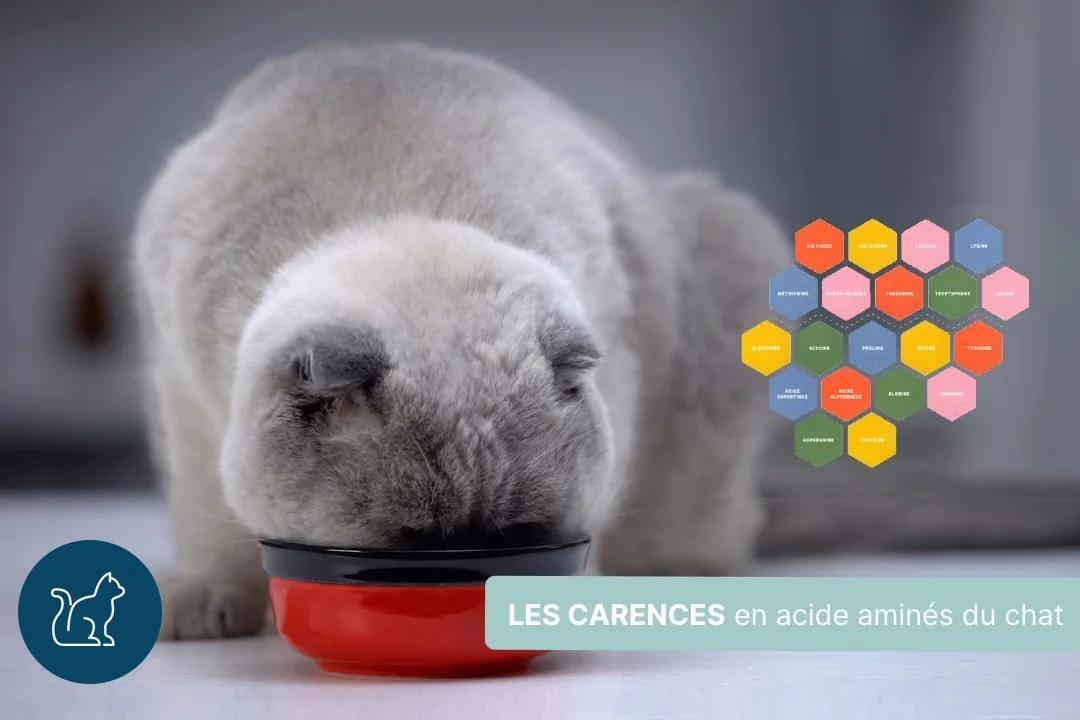
Amino acids are the basic constituents of proteins, their association allows to realize more or less long protein structures. Some proteins are composed of a few amino acids while others are composed of several tens.
NB: the good proteins that should be found in the cat's food are made up of a chain of 10 amino acids.
What is the difference between essential and non-essential amino acids?
Non-essential amino acids are those amino acids that are produced by the cat's body, such as :
➤ A lanine
➤ Asparagine
➤ Aspartate
➤ Cysteine
➤ Glutamate
➤ Glutamine
➤ Glycine
➤ Proline
➤ Serine
➤ TyrosineAs for the essential amino acids, the cat's body cannot produce them, which is why it is imperative that it find them in its food or in supplements:
➤ A rginine
➤ Histidine
➤ Isoleucine
➤ Leucine
➤ Lysine
➤ Methionine
➤ Phenylalanine
➤ Threonine
➤ Tryptophan
➤ ValineFor both dogs and cats, these 10 essential and 10 non-essential amino acids are identical.
But for the cat, it needs an essential amino acid in addition: taurine.
Indeed, if the dog's body produces this amino acid, the cat is not able to produce taurine. Therefore, taurine is a non-essential amino acid for the dog but essential for the cat.
Taurine, an essential amino acid that is more than necessary for cats.
This is how taurine contributes to a cat's good health:➤ Reproduction
➤ Heart
➤ Eyes
➤ MusclesNo non-essential amino acids without essential amino acids, why?
Yes, because only when there is no deficiency in essential amino acids can the cat's body produce its 10 non-essential amino acids.
No protein without amino acids.
In the diet, these amino acids are found in proteins and are not directly available. Once digested, the proteins release the amino acids which then pass into the bloodstream. According to the needs, new amino acids, which are assembled to form proteins, are then manufactured.
This cycle of production of new amino acids and proteins takes place continuously, which is why it is essential for the body to find all the essential amino acids it needs every day.
What are proteins used for?
Proteins are the basis of enzymes, which are substances necessary for body functions and help prevent diseases.
Although both cats and dogs need protein and amino acids, cats need them more because they break down protein much faster. It is impossible for the cat's body to adapt by slowing down the rate of breakdown when there is a lack of protein in the diet.
Proteins are essential to the cat's skeleton.
Proteins are structurally involved in :➤ bones
➤ muscles
➤ skin
➤ tendons
➤ joints and ligaments
➤ collagen ...Proteins also play a functional role in the production of:
➤ enzymes
➤ hormones
➤ antibodies ...How to cover the cat's needs in essential amino acids?
Share your experience or question with us in the comments ↓
-
 Health topics
Does my dog need bones?
01 January 2025
Read moreDoes my dog need bones? Can we give him bones regularly? Is it good for his health?
We explain the importance of bones to cover the dog's mineral needs for his health.
Many dog owners ask themselves these questions:
Does my dog need bones and why?
In order to understand the dietary needs of dogs, we need to get as close as possible to what canines eat in the wild. And even if we think that our dogs are far from the origins of wolves, foxes and other wild dogs. Their ancestral genetics are still present and it is this that makes their instincts speak.
Wolves and canids in the wild have their own way of feeding, as wolves have been extensively studied.
Wolves and wild dogs eat their prey in the following order:
1 the intestine in order to reseed their intestinal flora, which will allow them to fully assimilate the rest of their meal. This will allow them to properly metabolize vitamins and minerals and also to feed on predigested plants.
2 the liver, heart and lungs to take advantage of the vitamins that are widely present there.
3 They will cover their protein needs by eating red meat, especially the thighs, as this is where the highest levels of good protein (ten amino acid chains) are found.
4 And finally, they will quietly gnaw away at cartilage and bone to supplement themselves with minerals.
Do dog foods meet their needs as well as nature does?
Well, no and far from it, and without taking away the good intentions of the dog food manufacturers or the hardcore cooks. Let's face it: not everything is in kibble, nor is it in household food or Barf food for dogs
Despite our best efforts, we cannot meet the daily nutritional needs of our dogs.
If we go back to the feeding chronology of the canid in the wild, we can see that the first stage is already not well filled.
1 - The reseeding of the intestinal flora before each meal, the strategic operation that will make the dog assimilate its food bowl, metabolize vitamins and minerals, is very often absent from the formulations of dog food. (see article on the intestinal flora of dogs...)
Let's leave the following steps aside and move on to the subject of this article: minerals.
Minerals (also known as trace elements), which are much needed by dogs, are not found in sufficient quantities in the diet.What are the dog's mineral requirements?
Let's be very clear, the dog's need for minerals is enormous, it is much more important than the human need (not to be neglected).
For example, concerning calcium, numerous scientific studies have shown that a dog weighing 30 kilos generally needs about 3 times more calcium than an adult man weighing 80 kilos.
I supplement my dog with calcium, is that enough?
Still not because each mineral needs the others to be used correctly by the dog's body.
How do I know if my dog is mineral deficient?
The question no longer arises, we now know that if a dog is not supplemented with minerals, it will inevitably be deficient and its health will therefore be reduced.
Mineral deficiencies, any repercussions?
Our health advice
It is essential today to understand that for his health, we must supplement our dog in minerals, because all his needs are not found in the food. We have developed a natural food supplement, Total Minerals Dog, specifically rich in 75 natural minerals, to make up for mineral deficiencies in dogs.
Give your opinion by reacting in the comments ↓
On sale
100% natural guaranteed solutions












Paiement
Sécurisé

100% végétal
sans ogm

Fabriqué
en france

Livraison
rapide

Sans agents
chimiques
Newsletter Lore&Science
Subscribe and
Subscribe and
get 10% off